Onsite service is fully in English
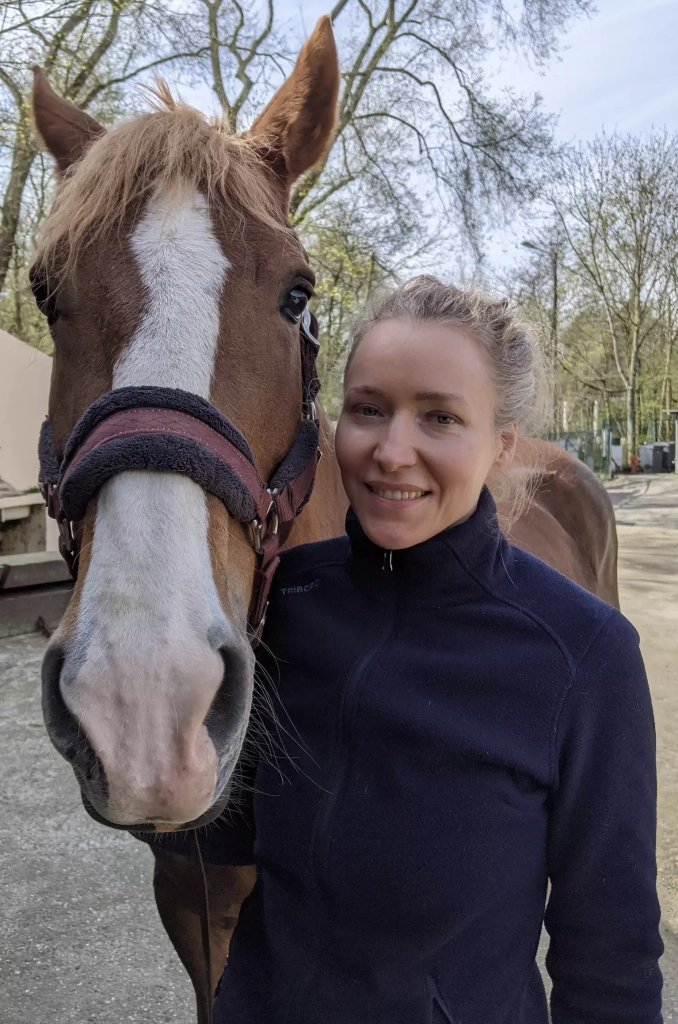
Equine Mind Body

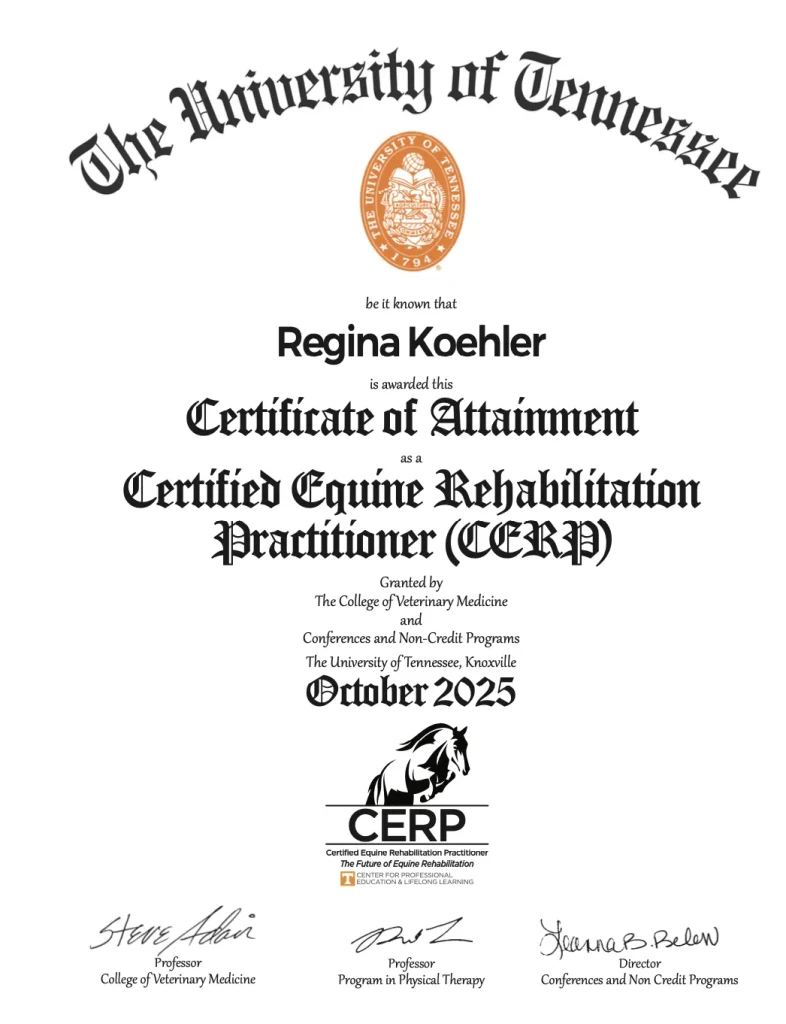
True to my German roots, efficiency is a core value at Equine Mind Body. This is why I design state-of-the-art performance enhancement, postural rehab and neuromuscular development programs. Thanks to my international and scientific training, these programs take into account the horse as a whole and also integrate insights from applied neuroscience.
Three complementary types of interventions together form a solid theoretical and practical foundation. They allow me to work flexibly across a wide range of goals, related to your horse’s wellbeing and performance. See the case studies (in French).
1 Physio and massage for equine performance, prevention, wellness

Objectives
- Restore proper function of the myo-fascial system (muscles and fascia) as a whole, improve athletic performance, and prevent CRS – chronic repetitive strain – the chronic wear in the horse’s body that underlies the majority of injuries (around 80%, source: Tanja Richter).
- Prevent joint dysfunctions (a muscle that functions physiologically no longer creates non-physiological pressure on the joints: prevention of subluxations, osteoarthritis, etc.).
- The joints are preserved and can function optimally: movement becomes harmonious and fluid, and the muscles can develop to their full potential.
- Physical stress (excessive effort beyond the horse’s physical capacity) or psychological stress also contributes to the development of myofascial trigger points.
- See cases Venise, Silver, Pégase, etc. (in French)

Tools and instruments: Manual and instrument-based treatments: analysis of conformation, static and dynamic posture, locomotion, massage, passive and active stretching / physiotherapy, interventions on fascia, scars, muscle hypertonicity, compressed nerves within hypertonic muscles or dehydrated/adherent fascia, etc. Soft tissue mobilization techniques: IASTM, vibrations, TENS, k-taping, etc.
2 Athletic conditioning and postural rehab. Fitness programs and training plans
In association with the myofascial and neuromuscular treatments described above
Objectives
- Postural and functional rehab, for example, a horse that adopts an « extension » posture in movement (hollowed back, head held high, avoidance of contact, etc.) cannot curve properly, cannot balance itself, and cannot engage and develop the correct muscle chains. A quality dynamic posture (the horse’s balance and maintenance in movement) forms the foundation of all performance improvement work and, even more so, prevention.
- Traumatic injuries or chronic fatigue/wear, post-surgical interventions, etc. (in coordination with your veterinarian and after their intervention, as per the french legislation).
- Locomotion asymmetries, etc., of unknown cause (post-veterinary intervention).
- Weight reduction if necessary: concerns 50% of equids in the developed world, representing a major health challenge for equids, particularly for joints, prevention of osteoarthritis, etc., and certain metabolic diseases; see the Equine Body Condition Score or body condition scoring.
- Fitness maintenance for the aging horse, support in cases of osteoarthritis.
- See cases Arkan, Héléa , etc.
Tools and instruments: exercises and training to achieve performance goals (dressage, race horses, show jumping, trail, endurance, western, working equitation, etc.). Restoration of functional posture using best practices in equine physiotherapy.
State of the art fitness rebuilding / (re)athleticization or rehab after a break / injury: muscle strengthening, cardiovascular training, coordination and proprioception, straightness, range of motion and balance, etc., post-convalescence or not. Learn more: equine physiotherapy, prevention and « prehabilitation », training, K-tape in training, work with body bands and balance cushions. »
3 Nervous system regulation, equine behaviour and human-horse partnership
Objectives
- Anxiety disorders, lethargy, aggression and dangerousness, reluctance, and other behavioral issues, taking into account all potential causes, whether physical or psychological (for example, bucking can originate from muscle contractures preventing the pelvic joints from functioning correctly, or from a relationship problem between the rider and the horse).
- Emotion regulation
- Psychological and physical resilience
- See cases Hannes , Atlas, Immortelle etc.
Tools: depending on your goals and challenges, focus on the quality of the relationship and interactions, the environment, enrichment, social adjustment, co-regulation and mutual trust, and clear, non-esoteric non-verbal communication.
Further reading (in French) Améliorer sa relation avec son cheval, Améliorer la santé mentale du cheval, Retrouver la confiance : le mental du cavalier
Why do Equine Mind Body interventions work so well? Because they combine a bottom-up and a top-down approach simultaneously.

Top-down approach: true relaxation begins in the horse’s mind and forms the foundation for all mounted or in-hand work. When the human-horse relationship is harmonious and based on trust, and when clear, effective communication exists between the two partners, the horse spends more time in parasympathetic mode (rest, digest, recover). This naturally leads to healthy muscle tone and a functional, balanced posture that is far easier to develop further – whatever the discipline or performance goal may be
Bottom-up approach because healthy muscles and fascia allow the nervous system to exit sympathetic tone. A horse that experiences less pain, that emerges from discomfort and constant physical restrictions, has less stress. It can exit a « sympathetic » activation—thus from the nervous system operating in « chronic stress » mode (chronic fight-flight-freeze). This prevents functional posture (typically the horse with head held high, stiff, hardened back, etc.). This mode is also toxic to the body and overall health in the long term (see studies on the impact of stress on cardiovascular function, immunity, etc.).
Areas of expertise
Physical and mental wellbeing, relationship with humans, and performance are closely linked in the horse. The services of Equine Mind Body combine these different areas of expertise in order to consider the horse as a whole
(translation to follow:)
Prévention | Préhabilitation | Entrainement
Equine Fascia & Trauma Release
« IASTM »: La mobilisation des tissus mous assistée par instrument
Le K-Tape (thérapie et entrainement)
Le comportement équin et la relation avec l’humain
Améliorer sa relation avec son cheval
Améliorer la santé mentale du cheval
Retrouver la confiance : le mental du cavalier